 the light edit.
You’ve seen the glowing masks on Instagram, heard about collagen on TikTok, and perhaps wondered whether your skincare routine needs another expensive addition. That’s a reasonable question. At-home facial light therapy is interesting—but it’s worth slowing down before you buy.
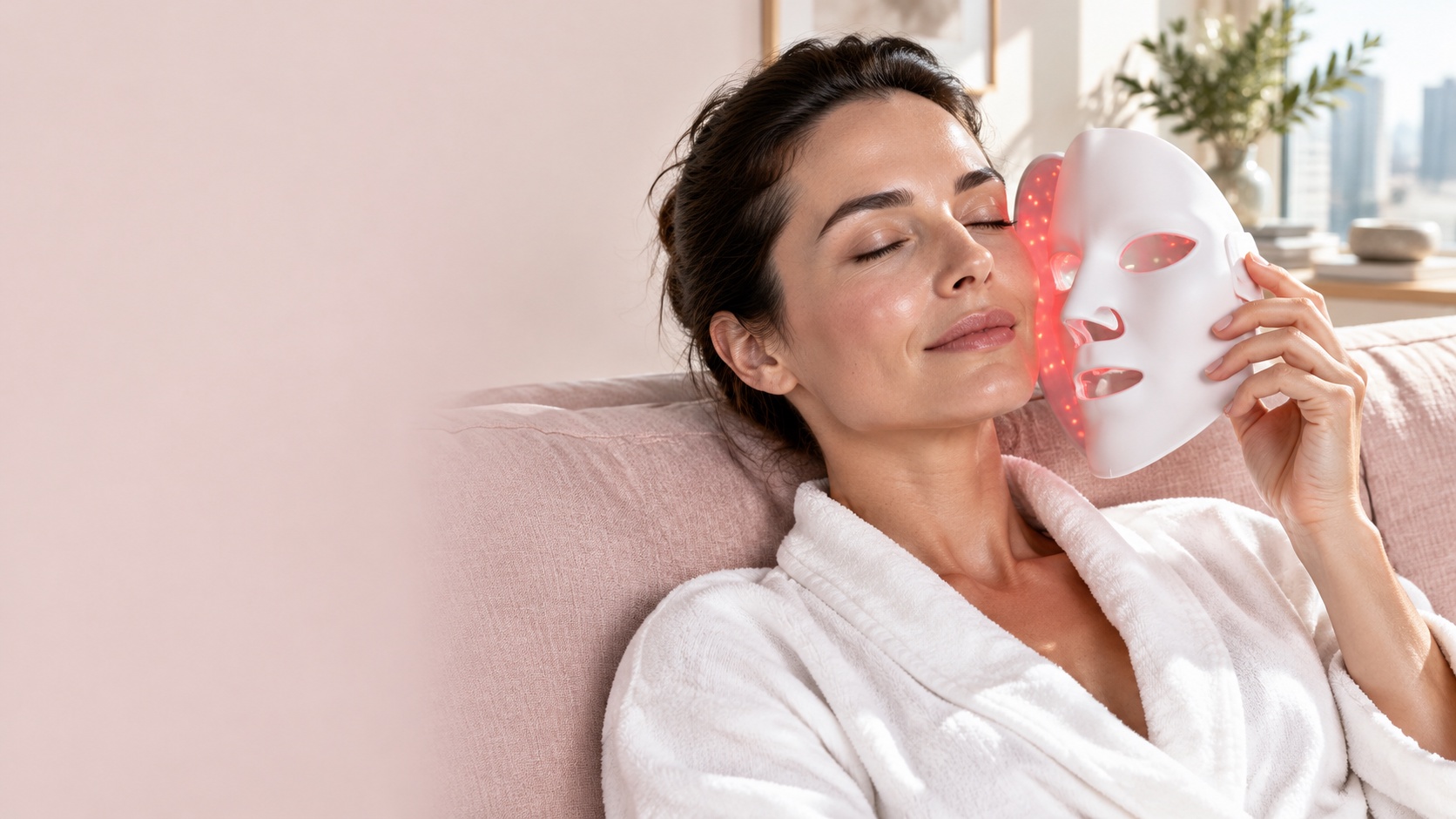
Generated editorial illustration; not a clinical demonstration or evidence of results.
Does LED red light facial therapy actually work?
The short answer: it may help with certain skin concerns, but it isn’t magic. Red and near-infrared light are studied for supporting improvements in signs of aging, and red or blue light devices are also studied for acne. Evidence varies by device, dose and condition.
The American Academy of Dermatology explains that in-office red light is more powerful than home devices, is often part of a broader treatment plan, and that more research is needed on at-home benefits. A mask is best viewed as a possible addition—not a replacement for established care.
The considered takeaway
Buy for a realistic, gradual possibility of improvement, not a promise to erase wrinkles, lift sagging skin or cure acne. If the cost would make you uncomfortable, a device is not an essential purchase.
Red, blue and near-infrared: what’s the difference?
Red light: visible, but not a universal solution
Red light is used in photobiomodulation research involving skin aging and acne. Its effects depend on more than color: wavelength, energy dose, treatment duration and how evenly the light reaches the skin all matter. A bright-looking mask isn’t necessarily a more effective one.
Near-infrared: invisible light, not invisible risk
Near-infrared light falls beyond the visible red spectrum and is included in some skin devices. Do not confuse a non-heating LED mask with heat-based infrared products. The fact that a wavelength is invisible does not mean you can ignore eye protection or session limits.
Blue light: a different skincare goal
Blue light is investigated particularly for acne, including its action on acne-associated bacteria. A mask that only offers red and near-infrared light should not automatically be treated as equivalent to a red-and-blue acne device. Ask which concern the exact model is intended to address.
A 2025 systematic-review conference abstract in JAAD reported improvements in acne outcomes across six trials involving 216 participants. The small evidence base, mixed devices and study variation mean this is not proof that every consumer mask works.
What results are reasonable to expect?
Fine lines, texture and firmness
Some people may see modest improvements, but timing and magnitude are not predictable for an individual. More treatment is not necessarily better. Do not transfer a brand’s before-and-after percentage to another model—or assume that everyone will see the same change.
Post-acne marks are not the same as scars
Active inflammatory acne, lingering redness, pigmentation and indented scars are different concerns. Evidence for acne does not establish that an LED mask will remove acne scars. A dermatologist can help distinguish the problem and recommend appropriate treatment.
At home versus in office
Home devices trade professional oversight and higher-powered equipment for convenience. They are not interchangeable with office procedures, and comparisons claiming the “same results at a fraction of the cost” need device-specific evidence. Follow professional advice if you are using a mask to maintain an in-office result.
Safety first: before you put on a mask
- Read your exact manual. Device settings, schedules and exclusions differ.
- Check medication and health conditions. Some medicines and light-sensitive conditions can make treatment unsuitable. Ask your clinician rather than stopping medication yourself.
- Follow eye-protection instructions. Closed eyes are not a substitute for protective eyewear when the manufacturer requires it.
- Consider your skin tone and pigmentation history. Ask a dermatologist about your risk if you are prone to pigmentation or have darker skin.
- Stop for symptoms. Pain, a rash or eye symptoms are reasons to stop and seek advice—not to push through.
For children, pregnancy, breastfeeding, a history of skin cancer or a diagnosed eye condition, do not assume a device is suitable: review its contraindications and speak with a healthcare professional. See the AAD’s precautions.
What if you have rosacea?
Rosacea deserves a tailored plan. A home LED mask is not an established substitute for prescription treatment, and sensitive skin may react poorly. IPL and vascular laser treatments offered for redness involve different technology. Speak with your dermatologist before experimenting.
How to choose an LED face mask
Start with your main concern, then compare the precise model—not simply the brand. A newer generation, a face-and-neck kit and a facial mask may all have different specifications.
| Compare | What to look for | Why it matters |
|---|---|---|
| Evidence | Studies on the exact model | General LED evidence is not a product guarantee |
| Light & dose | Wavelengths and clear instructions | More colors or LEDs are not automatically better |
| Fit & coverage | Straps, shape, eye protection | Comfort affects whether you keep using it |
| Long-term value | Warranty, returns, replacement parts | A costly unused device is poor value |
Models on the shortlist
CurrentBody Skin Series 2, Shark CryoGlow, HigherDOSE, Solawave Wrinkle Retreat, MEGELIN, Project E Beauty and Dr. Dennis Gross FaceWare Pro appear in our review collection. Their inclusion is not proof of equal efficacy or a hands-on endorsement.
For example, the manufacturer lists CurrentBody Series 2 with red 633nm, near-infrared 830nm and 1072nm light and a 10-minute session. The FDA’s Series 2 clearance letter records a substantial-equivalence decision; clearance is not a promise of a particular outcome.
Compare the product reviewsWhat about Joovv infrared light?
If you’re researching joovv infrared light alongside masks, compare the exact panel’s instructions, treatment distance and intended use rather than borrowing a face-mask schedule. A panel is a different format. We have not evaluated a specific Joovv model here, so we do not give model-specific specifications or recommend one.
And Skin Gym Revilit LED light therapy?
Skin Gym Revilit is another search shoppers may encounter. We have not independently verified the exact model’s specifications or clinical evidence for this guide. Use the same buying checklist, and do not assume a similar-looking device delivers the same treatment.
Making room for light in your routine
Use the schedule on the label
There is no single frequency that fits every LED mask. Use only the duration and frequency given for your model and treatment mode. Do not stack sessions, increase exposure or use multiple devices on the same area just to accelerate results.
Keep the rest simple
Follow the manufacturer’s skin-preparation instructions, often involving clean skin. Do not assume serums, acids, retinoids or oils belong underneath a mask. Apply products only as allowed by the device and product instructions. Keep sunscreen in your daytime routine; LED is not UV protection.
Track changes without chasing perfection
If you take progress photos, use the same lighting and angle and avoid filters. Notice comfort and irritation as well as cosmetic changes. Reassess if the routine is burdensome or the benefits do not justify the cost.
Do you need companion skincare?
No branded serum or accessory is automatically essential. Our collection includes Solawave neck-and-chest devices and its Radiant Renewal wand, HigherDOSE Glow Serum and a copper dry brush, plus MZ SKIN serums, eye care, SPF and ampoules. These products serve different roles; neither a serum nor a dry brush is evidence that an LED mask works better.
Explore MZ SKIN Tint & Protect SPF 30 and Solawave Neck & Chest with those distinctions in mind.
Your LED questions, answered
Does an LED red light therapy mask really work?
Red and near-infrared light may help some people see modest improvements in fine lines and skin texture. Results depend on the device, treatment schedule and your skin. The American Academy of Dermatology notes that home devices are less powerful than in-office treatment and that more research is needed. Think gradual support—not a facelift, an overnight transformation or guaranteed results.
What are the downsides of using an LED face mask?
The upfront cost, regular time commitment and variable results are real trade-offs. Temporary irritation can occur. Certain medicines and medical conditions increase light sensitivity, and eye protection is device-specific. Check the manual, talk with your dermatologist if you are unsure, and stop if you notice pain, a rash or eye symptoms.
Can red light therapy be used to treat rosacea?
Do not assume a consumer LED mask is an established rosacea treatment. Rosacea can involve sensitivity and flushing, so speak with a dermatologist before trying one. Professional treatments for visible vessels may use different technologies, such as IPL or lasers; those are not the same as a home red light mask.
How often should you use an LED light face mask?
Follow the instructions for your exact model and mode. There is no universal schedule: session length and frequency vary across devices. Start only after reviewing contraindications, do not double up sessions to chase faster results, and use any eye protection the manufacturer specifies.
Evidence & safety: American Academy of Dermatology
Sources, limitations & disclosure
This guide draws on professional dermatology guidance, a published research abstract and model-specific manufacturer and FDA documentation linked above. Manufacturer claims are not independent clinical conclusions. We have not conducted hands-on tests or had this guide individually reviewed by a clinician.
Search research used US data; search interest does not establish product efficacy. Product versions and stock change. We do not quote unverified live prices or claim guaranteed results.
Some shopping links supplied in the editorial brief are affiliate links. Their destinations and affiliate enrollment have not been independently confirmed. Please verify the exact seller and model before you buy.
Ready to investigate one option? View the supplied CurrentBody Series 2 listing, or return to all research reviews.